
DEMO
Latest Wordspress.org News
WordPress 6.9 “Gene”
WordPress 6.9, code-named “Gene,” brings major upgrades to how teams collaborate and create. The Notes feature introduces block-level commenting to streamline reviewing and polishing content, navigating across the entire dashboard with the Command Palette is now faster for power users, and the new Abilities API provides a standardized way to open the door for AI-powered and automated workflows. Combined with all the performance and accessibility improvements, 6.9 is one to write home about.
WordPress 6.9 Release Candidate 3
The third Release Candidate (“RC3”) for WordPress 6.9 is ready for download and testing! This version of the WordPress software is under development. Please do not install, run, or test this version of WordPress on production or mission-critical websites. Instead, it’s recommended that you evaluate RC3 on a test server and site. Reaching this phase of the release cycle is an important milestone. While release candidates are considered ready for release, testing remains crucial to ensure that everything in WordPress 6.9 is the highest quality possible. You can test WordPress 6.9 RC3 in four ways: Plugin Install and activate the WordPress […]

WordPress 6.9 Release Candidate 2
The second Release Candidate (“RC2”) for WordPress 6.9 is ready for download and testing! This version of the WordPress software is under development. Please do not install, run, or test this version of WordPress on production or mission-critical websites. Instead, it’s recommended that you evaluate RC2 on a test server and site. Reaching this phase of the release cycle is an important milestone. While release candidates are considered ready for release, testing remains crucial to ensure that everything in WordPress 6.9 is the best it can be. You can test WordPress 6.9 RC2 in four ways: Plugin Install and activate the […]

WordPress 6.9 Release Candidate 1
The first Release Candidate (“RC1”) for WordPress 6.9 is ready for download and testing! This version of the WordPress software is still under development. Please do not install, run, or test this version of WordPress on production or mission-critical websites. Instead, it’s recommended to evaluate RC1 on a test server and site. WordPress 6.9 RC1 can be tested using any of the following methods: Plugin Install and activate the WordPress Beta Tester plugin on a WordPress install. (Select the “Bleeding edge” channel and “Beta/RC Only” stream.) Direct Download Download the RC1 version (zip) and install it on a WordPress website. Command […]



Pagination
Paginate in case of huge items number
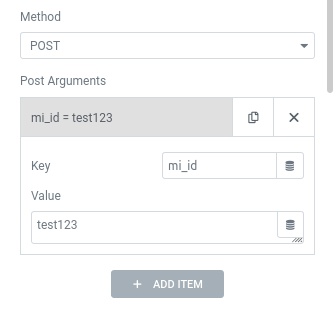
POST Request
Send Post payload data on your request call
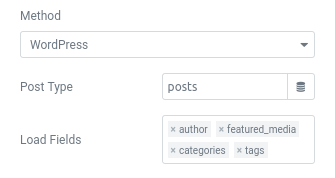
WordPress Rest API
Full support to native API
ElasticSearch
Full support to Elastic API to read Documents
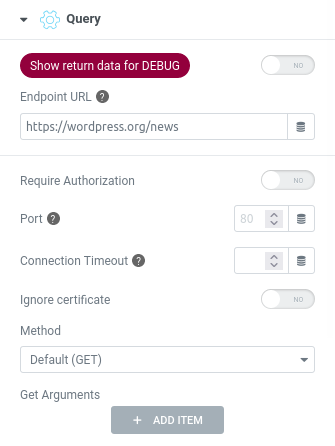
Query Rest API
EndPoint URL
The remote url of API service
Require Authorization
Optional User and Password or Token access for private area
Port
Set if different from default 80
Connection Timeout
Sometimes the service could be longer than standard timeout
Ignore certificate
Enable it if remote service is not on ssl
Method
Many ways to manage request data and manipulate the response, some generics like standard GET and POST and more specific for WORDPRESS and ELASTICSEARCH
Parameters
GET & POST extra arguments
If you need to pass more data into your request, like authentication info, filter values, etc, you can add them defining for each one its own key accepted by the service and its value, maybe loaded via Dynamic Tag

WordPress Native API REST
Post Type
Set here the name of your CPT or leave default posts visualization.
Also different object types are supported, like “users”, “categories” and so on
Load Fields
By default you get only the ID of related post objects, like:

- Author
- Feature Media
- Categories
- Tags
Enable them to get full data of those object.
WARNING: this will increase load time, because each object require an extra request to WP remote service

Elastic Search
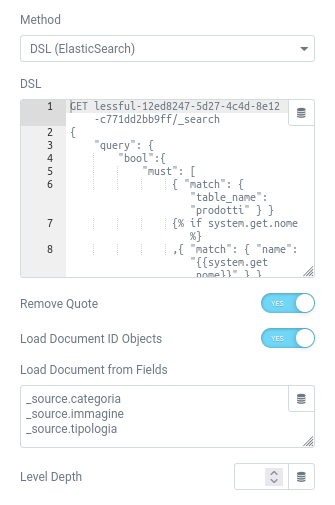
DSL
You can write your custom Query DSL (optionally dynamic with Twig), copy it from Kibana and execute here
Remove Quote
Optional, clean _source data from extra quotes added by elastic response
Load Document ID Object from Fields
Enable it to retrieve full data of main fields referenced only by Document ID.
Specify all fields, once per line, you want to fill with full data. Separate sub keys with a dot.
Level Depth
Maybe you need to expand fields of loaded documents nested on main document, so define how many iteration recursion you want to execute
WARNING: this will increase load time, because each Document require an extra request to Elastic remote service
Archive Rows
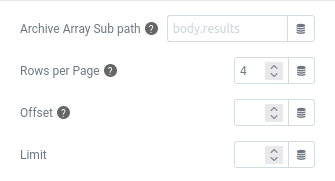
Archive Array Sub path
Set here optionally the index of sub array into the JSON result, separate each level with a dot
Rows per Page
Define how many result per page, necessary if activate the Pagination
Offset/Limit
Optional to modify the results display number
Cache
You can optimize page load with Enable Cache which will be valid for a defined amount of time until it will be refreshed.
Rest API Fields
We wanted to create a way to visualize, sort, and manage every type of data into the spreadsheet to generate complete lists in all its parts.
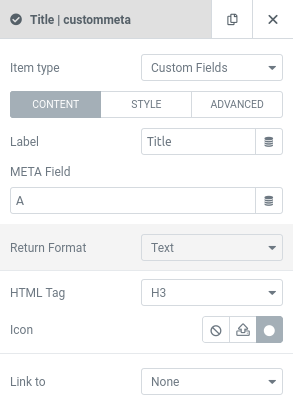
Display elements
- Custom Field, a column field
- Static (text, image, icon, code)
- Loop Index
- A custom Elementor Template
Each type of element is customizable in all its parts with dedicated parameters in order to achieve maximum control.
Style
All configurations for the style are accessible immediately while creating the items.
Advanced
As if that wasn’t enough, some advanced parameters let you refine the visualization and its behavior.
Query Rest API
SKINS
Several display styles are available for all e-Query widgets that will allow you to get the navigation approach you want.
e-Developer