
DEMO
Latest Wordspress.org News
Piloting the AI Leaders Micro-Credential
Today, we are happy to announce our first WordPress-focused micro-credential, designed to help students build practical AI skills, earn a recognized credential, and connect more directly to job opportunities. The program, AI Leaders, is a workforce-oriented credential rooted in WordPress and open source contributions. Students are paid for their time, work on real WordPress projects, and gain hands-on experience applying AI in ways that are directly relevant to the WordPress ecosystem. This pilot represents a meaningful step forward in how the project supports learning, contribution, and career pathways. Beginning in March 2026, AI Leaders launches its first cohort of 80 students […]
WordPress 6.9.1 Maintenance Release
WordPress 6.9.1 is now available! This minor release includes fixes for 49 bugs throughout Core and the Block Editor, addressing issues affecting multiple areas of WordPress including the block editor, mail, and classic themes. For a full list of bug fixes, please refer to the release candidate announcement. WordPress 6.9.1 is a short-cycle maintenance release. The next major version of WordPress will be 7.0; it is scheduled for release on 9 April 2026 at WordCamp Asia. If you have sites that support automatic background updates, the update process will begin automatically. You can download WordPress 6.9.1 from WordPress.org, or visit your […]
New AI Agent Skill for WordPress
Faster Way For AI Agents To Test AI code agents are getting better at writing WordPress plugins and themes, but testing can still be the slow part. WordPress contributor Brandon Payton has published wp-playground, a new AI agent skill designed to run WordPress via the Playground CLI, giving agents a fast, repeatable way to run WordPress and verify their work as they iterate. “AI agents work better when they have a clear feedback loop. That’s why I made the wp-playground skill. It gives agents an easy way to test WordPress code and makes building and experimenting with WordPress a lot more […]
Be Part of WordCamp Asia 2026
WordCamp Asia is back in 2026, this time in Mumbai, India, and it’s building on a year that showed just how ambitious and connected the WordPress community has become. Now is the time to get involved. Get your ticket, explore sponsorship opportunities, and help spread the word. In 2025, more than 1,400 attendees from 71 countries gathered in person, with nearly 15,000 more joining online for WordCamp Asia 2025. With notable guests like WordPress Co-founder Matt Mullenweg and Gutenberg Lead Architect Matías Ventura, and a diverse lineup of speakers and panelists from across the ecosystem, WordCamp Asia 2025 brought together a community actively shaping […]
Pagination
Paginate in case of huge items number
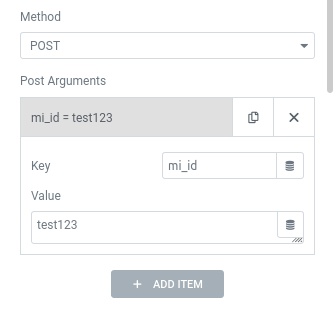
POST Request
Send Post payload data on your request call
WordPress Rest API
Full support to native API
ElasticSearch
Full support to Elastic API to read Documents
Query Rest API
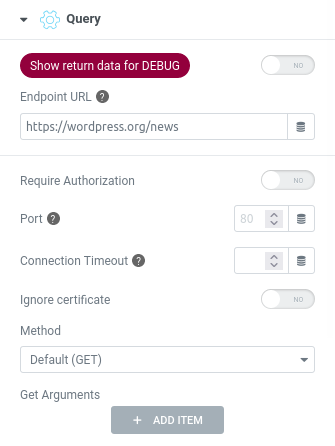
EndPoint URL
The remote url of API service
Require Authorization
Optional User and Password or Token access for private area
Port
Set if different from default 80
Connection Timeout
Sometimes the service could be longer than standard timeout
Ignore certificate
Enable it if remote service is not on ssl
Method
Many ways to manage request data and manipulate the response, some generics like standard GET and POST and more specific for WORDPRESS and ELASTICSEARCH
Parameters
GET & POST extra arguments
If you need to pass more data into your request, like authentication info, filter values, etc, you can add them defining for each one its own key accepted by the service and its value, maybe loaded via Dynamic Tag

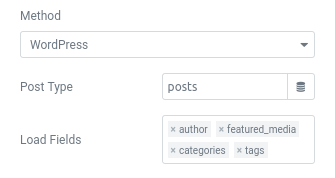
WordPress Native API REST
Post Type
Set here the name of your CPT or leave default posts visualization.
Also different object types are supported, like “users”, “categories” and so on
Load Fields
By default you get only the ID of related post objects, like:

- Author
- Feature Media
- Categories
- Tags
Enable them to get full data of those object.
WARNING: this will increase load time, because each object require an extra request to WP remote service

Elastic Search
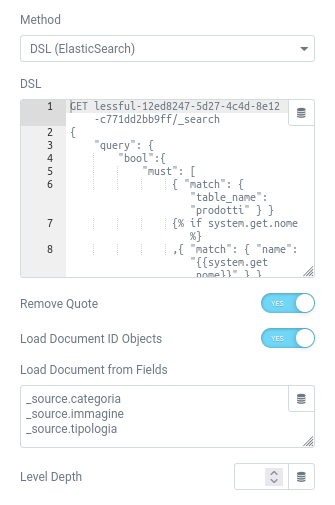
DSL
You can write your custom Query DSL (optionally dynamic with Twig), copy it from Kibana and execute here
Remove Quote
Optional, clean _source data from extra quotes added by elastic response

Load Document ID Object from Fields
Enable it to retrieve full data of main fields referenced only by Document ID.

Specify all fields, once per line, you want to fill with full data. Separate sub keys with a dot.
Level Depth
Maybe you need to expand fields of loaded documents nested on main document, so define how many iteration recursion you want to execute

WARNING: this will increase load time, because each Document require an extra request to Elastic remote service
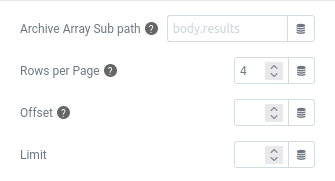
Archive Rows
Archive Array Sub path
Set here optionally the index of sub array into the JSON result, separate each level with a dot
Rows per Page
Define how many result per page, necessary if activate the Pagination
Offset/Limit
Optional to modify the results display number
Cache
You can optimize page load with Enable Cache which will be valid for a defined amount of time until it will be refreshed.
Rest API Fields
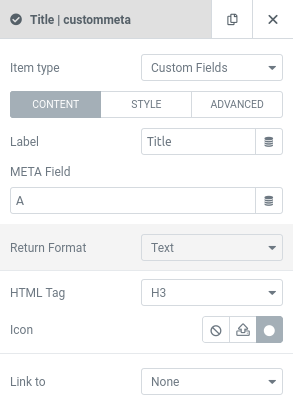
We wanted to create a way to visualize, sort, and manage every type of data into the spreadsheet to generate complete lists in all its parts.
Display elements
- Custom Field, a column field
- Static (text, image, icon, code)
- Loop Index
- A custom Elementor Template
Each type of element is customizable in all its parts with dedicated parameters in order to achieve maximum control.
Style
All configurations for the style are accessible immediately while creating the items.
Advanced
As if that wasn’t enough, some advanced parameters let you refine the visualization and its behavior.
Query Rest API
SKINS
Several display styles are available for all e-Query widgets that will allow you to get the navigation approach you want.
e-Developer